
Important CBP Updates for Exporters Shipping to the U.S.
[29 May 2026] Important Updates from U.S. Customs and Border Protection (CBP) for Exporters Shipping to the United States
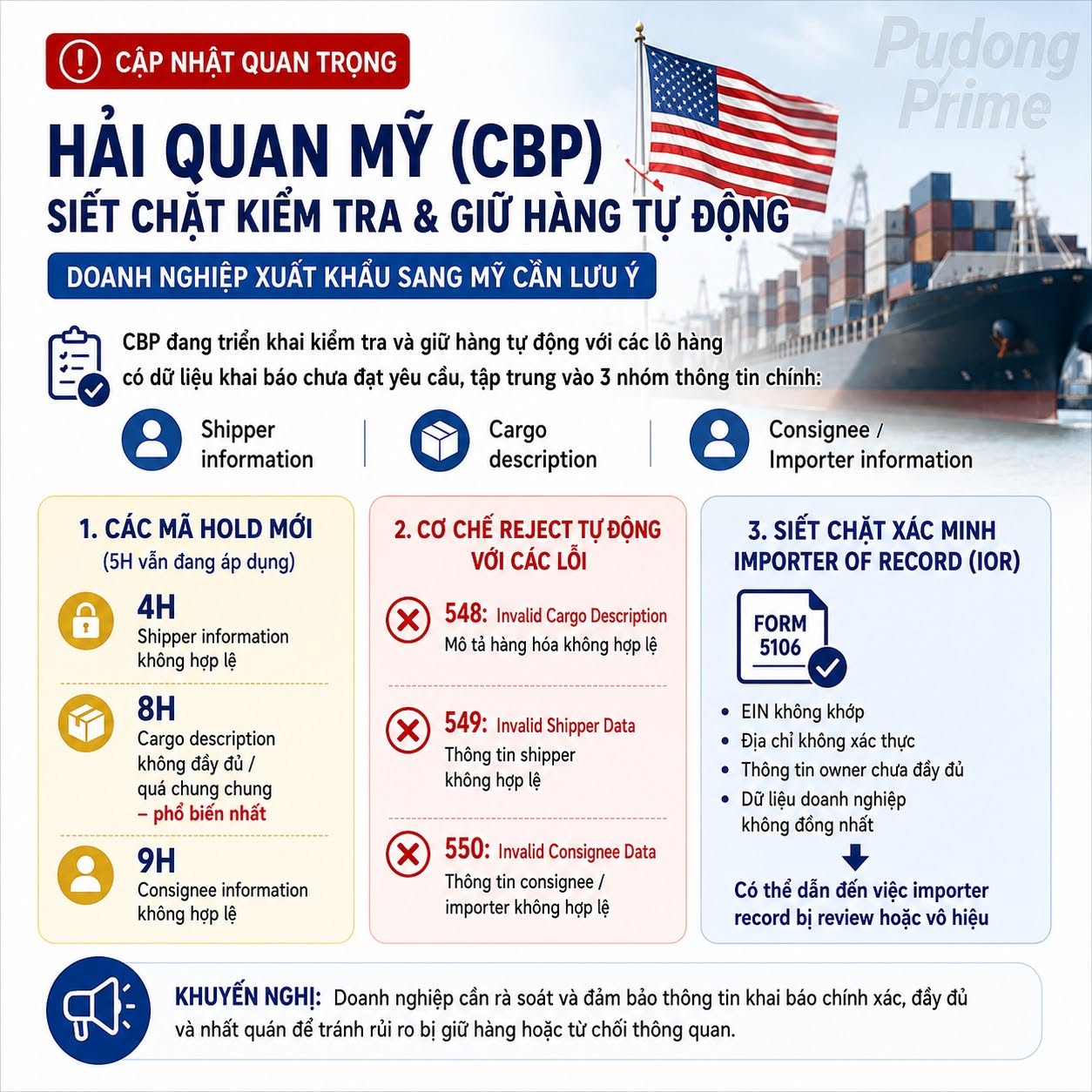
According to the latest updates from U.S. Customs and Border Protection (CBP), new automated screening measures have been implemented for import shipments entering the United States. Shipments with incomplete or non-compliant declaration data may now be automatically held for further review.
CBP is currently placing greater emphasis on the following three key areas of shipment information:
- Shipper Information
- Cargo Description
- Consignee / Importer Information
Key Updates
CBP has introduced additional automated hold codes (in addition to the existing 5H hold for system-selected Entry Summary reviews):
- 4H – Invalid or incomplete Shipper Information
- 8H – Inadequate or overly generic Cargo Description (currently the most common issue)
- 9H – Invalid or incomplete Consignee Information
In addition, CBP has implemented automatic rejection codes for the following data validation errors:
- 548 – Invalid Cargo Description
- 549 – Invalid Shipper Data
- 550 – Invalid Consignee / Importer Data
Enhanced Importer of Record (IOR) Verification
CBP has also strengthened its verification process for the Importer of Record (IOR) through CBP Form 5106.
Importers may be subject to review or deactivation if any of the following issues are identified:
- Mismatched EIN (Employer Identification Number)
- Unverified or inaccurate business address
- Incomplete ownership or officer information
- Inconsistent company records across CBP databases
The updated Form 5106 now requires additional information, including:
- Company Officer’s Full Name
- Passport Number or Social Security Number (SSN)
- Passport Issuing Country
- Passport Expiration Date
These requirements are intended to verify the beneficial ownership of U.S. importers.
Recommendations for Exporters
To minimize the risk of shipment delays or customs holds, exporters are strongly advised to:
- Verify the accuracy of both Shipper and Consignee information before shipment.
- Confirm the validity of the Importer of Record (IOR) and ensure Form 5106 is complete and up to date.
- Use clear, detailed, and accurate cargo descriptions that properly reflect the nature of the goods.
- Ensure all shipping documents are complete, consistent, and supported by the correct HS Codes.
- Coordinate with your customs broker in advance to verify compliance before manifest submission and review any applicable Partner Government Agency (PGA) requirements.
- Avoid using borrowed IORs, rented importer accounts, shell companies, or fraudulent EINs.
- Carefully review customs bond requirements, particularly for first-time importers.
Source: PassionShip | TEU Global
